Story cubes / story dice prompts
CostLow
Includes: commercial Story Cube sets, blank dice for DIY, printable prompt decks Example: Rory’s Story Cubes sets from €12–25; blank dice packs from €10–20
What it is
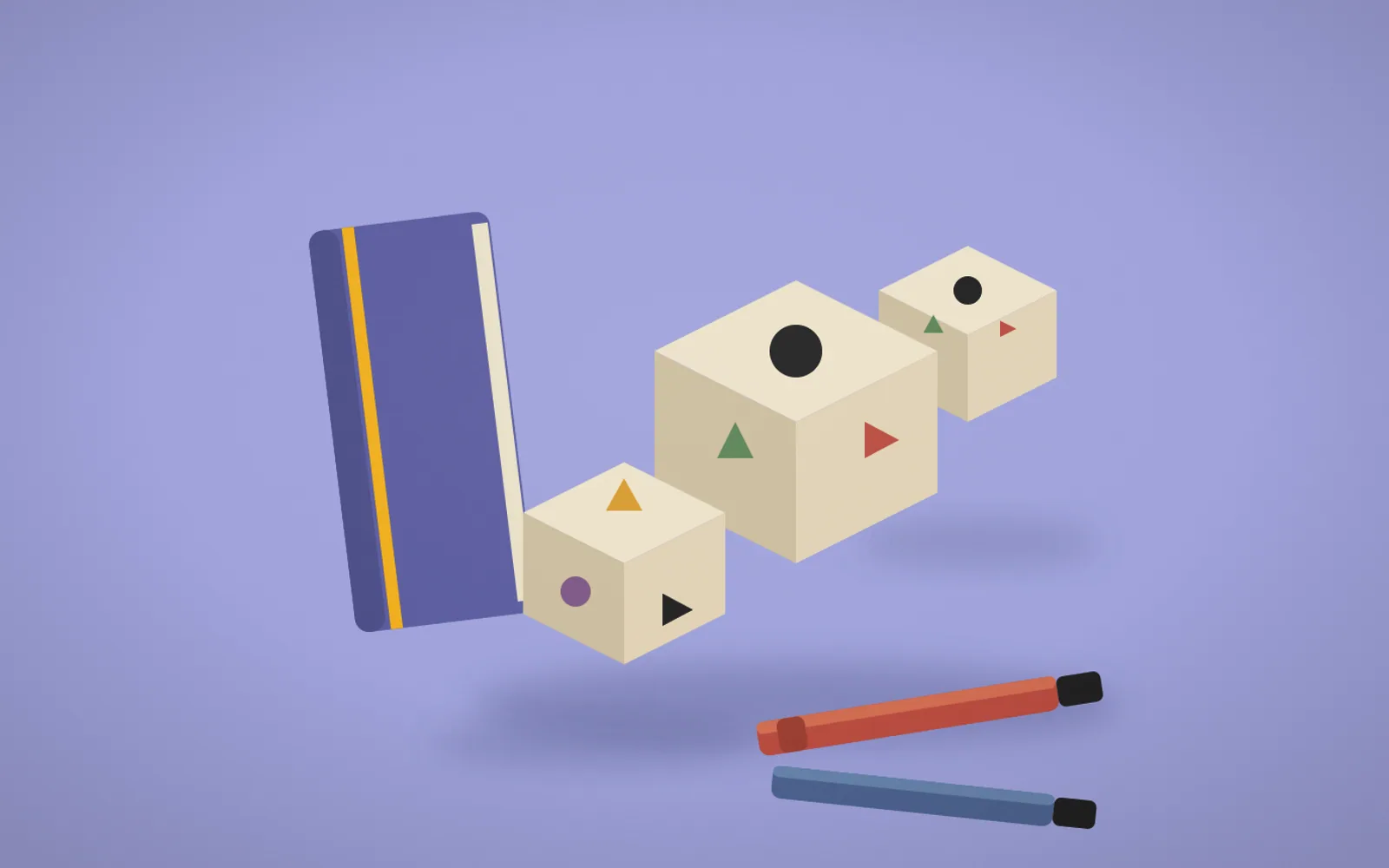
Constraint is the cure for the blank page, not the enemy of it. Story cubes prove it in the most physical way possible. They are dice with pictures instead of numbers, a bridge, a key, a sheep, a question mark, and you roll a handful, then build a story that links every image that comes up. The randomness is the gift. You did not choose these elements, so you cannot fall back on your usual ideas, and that forces genuine invention.
The mechanic is dead simple. Roll, say, nine cubes. Read the images left to right as a rough beginning, middle, and end, or arrange them however inspiration suggests, and tell a story that incorporates all of them. There are no wrong answers and no winning. The only rule is that every rolled image has to earn its place in the tale, which is exactly the constraint that makes the imagination work rather than freeze.
The applications stretch well beyond a single person amusing themselves. They are a staple in classrooms for prompting reluctant writers, in speech therapy, in language learning, and in family games where each person adds a sentence built around the next die. The same nine cubes never produce the same story twice, partly because the combinations are vast and partly because two people will read the same key icon as a clue, a betrayal, or a literal door key.
The honest limit is that story cubes are a spark, not an engine. They get you started brilliantly and leave the actual storytelling to you, which is the point but can frustrate anyone expecting more structure. Treated as a launchpad rather than a crutch, they reliably break the most stubborn creative block there is, the one where you simply cannot think of anything to begin with.
How it works
The instinct beginners fight is forcing the images into the order they were rolled, treating it like a strict sequence. That makes for stiff, list-like stories. The dice are raw material, not a running order. Roll your handful, usually nine, look at all the images together, and find the connection that interests you before deciding what comes first. The freedom to arrange is where the storytelling actually happens.
Roll, then read the images as a loose prompt rather than a script. A bridge, a key, a sheep, a question mark, a moon. Your only rule is that every rolled image has to earn a place somewhere in the tale, which is exactly the constraint that forces invention. Some people use a rough three-act split, the first three dice for setup, the middle three for complication, the last three for resolution, but that is a scaffold to abandon the moment a better shape appears.
The interpretive leap is the skill, and it loosens with practice. A key icon can be a literal key, or a clue, or a betrayal, or the answer to a problem, or a person who unlocks something in another character. The same nine cubes never produce the same story twice, partly because the combinations are vast and partly because two people read the same images completely differently. Pushing past the literal reading of each image is what turns a flat inventory into an actual narrative.
Played in a group it becomes a passing game, each person adding a sentence or a scene built around the next die, and the story veers somewhere no single person intended. Solo, it is a daily warm-up against the blank page. Either way, do not aim for polish. Story cubes are a spark, not an engine. They reliably break the where do I even start block, and the rough story they produce is the point, not a draft to perfect.
Benefits
What you need
Here's what to gather before you start. The essentials are marked.
Some links below are affiliate links. As an Amazon Associate, trylii.com earns from qualifying purchases, at no extra cost to you.
FAQs
Dice with pictures instead of numbers, a key, a bridge, a question mark, on each face. You roll them and build a story that links every image that comes up. There are no winners or rules to break. The pictures are prompts, and your job is to weave them into something that hangs together, however loosely.
No, though it works wonderfully with them. Adults use story cubes for creative warm-ups, breaking writer's block, and improv practice. The constraint of a fixed set of random images is exactly what loosens a stuck imagination, which is why writers and improvisers reach for them as much as families do.
No. Rory's Story Cubes is the well-known commercial set and it is nicely made, but you can write images on blank dice, cut pictures into a hat to draw from, or use a random-image app. The mechanism is "random prompts you must connect", and anything that delivers that works just as well.
Three is a friendly starting number, building up to nine as you get comfortable. Too few and the story is thin. Too many at once and beginners freeze trying to cram everything in. A good middle approach is rolling all nine but only requiring you to use, say, six, so you can drop the one image that refuses to fit rather than forcing it.
You might also like
 MIND
Constrained writing challenges
MIND
Constrained writing challenges
 MIND
Visual brain teasers
MIND
Visual brain teasers
 MIND
Riddle creation & solving
MIND
Riddle creation & solving
 MIND
Writing personal mantras
MIND
Writing personal mantras
 MIND
Time blocking experiments
MIND
Time blocking experiments
 MIND
Fact-a-day journals
MIND
Fact-a-day journals
 MIND
Spoonerism wordplay
MIND
Spoonerism wordplay
 MIND
Flash fiction writing
MIND
Flash fiction writing
 MIND
Hashi (bridges) puzzles
MIND
Hashi (bridges) puzzles
 MIND
Future self letters
MIND
Future self letters
 SKILL
Building DIY speakers
SKILL
Building DIY speakers
 SKILL
Making a simple electric guitar
See all in Mind at Play
SKILL
Making a simple electric guitar
See all in Mind at Play