Pattern block puzzles
CostLow
Includes: wooden or magnetic block sets, pattern cards, magnetic boards if desired Example: quality wooden sets from €20–50; larger classroom kits around €100–150
What it is
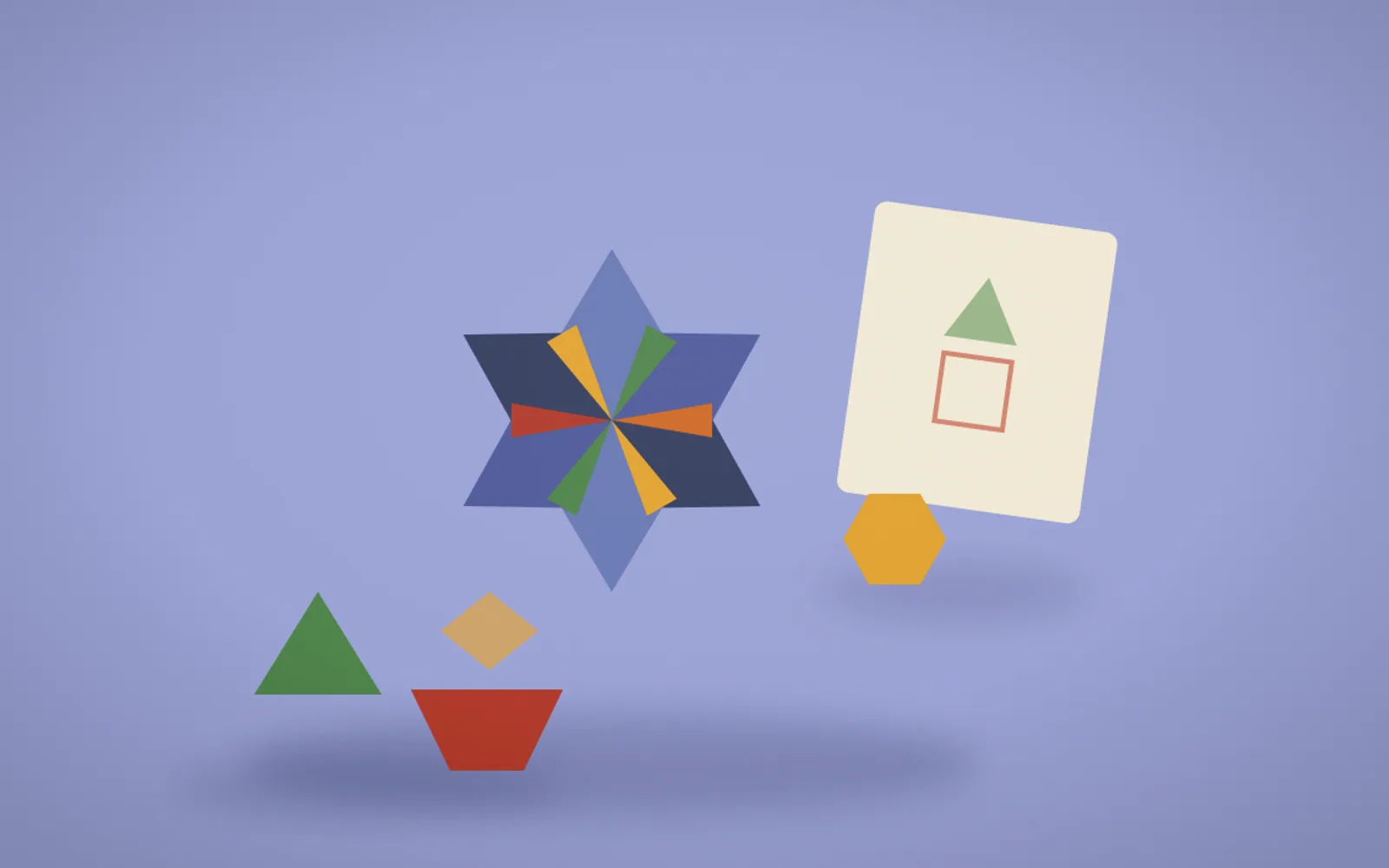
A jigsaw has one solution. Pattern blocks have thousands. That difference is the whole appeal. Pattern block puzzles use a set of coloured geometric tiles, the classic set has six shapes, green triangles, blue rhombi, red trapezoids, yellow hexagons, orange squares, and tan rhombi, which you arrange to fill outlines, build symmetrical designs, or tile a plane. Unlike a puzzle with a single right answer, most pattern block challenges have many valid solutions, so the activity sits somewhere between puzzle and open creation.
The pieces are designed to relate to each other mathematically, and that is the quiet genius of the set. Two green triangles make a blue rhombus, three make a red trapezoid, six make a yellow hexagon, so the shapes nest and combine in ways that make geometric relationships physical and obvious. Fill a hexagon outline and you can do it with one yellow piece, or two trapezoids, or three rhombi, or six triangles, or any mix, and seeing those equivalences with your hands teaches fractions and symmetry better than any diagram.
The challenges range widely. Some ask you to fill a given outline using the fewest pieces, or the most. Some are about creating symmetrical or repeating patterns. Some are pure free building, where the only goal is to make something that pleases you. This range is why the same set works for a four-year-old stacking shapes and an adult exploring tessellation, and why pattern blocks remain a fixture in maths classrooms decades after their introduction.
The honest limit is that pattern blocks can feel too open for people who want a defined problem with a defined solution. Without a specific challenge, some find the lack of a right answer unsatisfying rather than freeing. Paired with a constraint, though, fill this shape with exactly these rules, they become a genuinely absorbing spatial puzzle, and the tactile pleasure of clicking coloured shapes into a clean tessellation is hard to overstate.
How it works
Lay out the six shapes and learn how they relate before tackling any challenge, because the whole activity runs on those relationships. The classic set has green triangles, blue rhombi, red trapezoids, yellow hexagons, orange squares, and tan rhombi. The crucial facts: two green triangles make a blue rhombus, three make a red trapezoid, six make a yellow hexagon, and a trapezoid plus a rhombus also makes a hexagon. Knowing these equivalences turns the pieces from random shapes into a system you can reason with.
Pick your challenge type, because they demand different approaches. Filling a given outline with the fewest pieces means reaching for the largest shapes that fit, the hexagon and trapezoid, and only using triangles to finish gaps. Filling it with the most pieces means the opposite, breaking everything down into single triangles. Building symmetrical designs means working outward from a centre and mirroring each placement. Free building has no goal but pleasing yourself. The same outline can usually be filled many valid ways, which is what separates this from a single-solution jigsaw.
For outline-filling, start from the edges and corners inward. The boundary constrains which pieces can sit against it, especially at angled corners where only certain shapes fit the angle, so committing the edges first narrows the interior choices. The angles all being multiples of 30 degrees is why the pieces tessellate so cleanly, and matching a piece's angle to the corner you are filling is the core spatial move.
Use the substitution trick when you get stuck. If a space will not take the piece you reach for, remember that a hexagon-shaped gap accepts one hexagon, or two trapezoids, or three rhombi, or six triangles, or any valid mix. Mentally swapping a large piece for its equivalent smaller pieces, or vice versa, is how you slot a fill into a space that first looked wrong, and it is the same reasoning that makes the blocks such a good concrete model for fractions.
Benefits
What you need
Here's what to gather before you start. The essentials are marked.
Some links below are affiliate links. As an Amazon Associate, trylii.com earns from qualifying purchases, at no extra cost to you.
FAQs
Coloured geometric shapes, the classic set has green triangles, blue rhombuses, red trapezoids, yellow hexagons, that you fit together to fill a given outline or build a pattern. They are common in classrooms for teaching geometry and fractions, but adults find them quietly meditative too. It is spatial play with simple, satisfying pieces.
No, though they are designed with kids in mind. The same blocks support genuinely tricky challenges, filling a shape using the fewest pieces, or only certain colours, or exploring how shapes tessellate. The simplicity is deceptive. Constraints turn a children's toy into a real spatial puzzle for any age.
A feel for how shapes relate, how three triangles make a trapezoid, how six make a hexagon, which is geometry you absorb through your hands rather than a textbook. Beyond that, they are a calm, tactile reset, the kind of low-stakes spatial fiddling that occupies the hands and settles the mind without demanding much.
You might also like
 MIND
Six-word stories
MIND
Six-word stories
 MIND
Digital declutter routine
MIND
Digital declutter routine
 MIND
Crosswords
MIND
Crosswords
 MIND
Constrained writing challenges
MIND
Constrained writing challenges
 MIND
Mechanical puzzles (twisty puzzles, puzzle boxes)
MIND
Mechanical puzzles (twisty puzzles, puzzle boxes)
 MIND
Tangrams
MIND
Tangrams
 MIND
Journaling
MIND
Journaling
 MIND
Collaborative story writing (pass the story)
MIND
Collaborative story writing (pass the story)
 MIND
Paper folding puzzles (beyond origami: puzzle-folds)
MIND
Paper folding puzzles (beyond origami: puzzle-folds)
 MIND
Daily gratitude journaling
MIND
Daily gratitude journaling
 WILD
Rope and knot skills
WILD
Rope and knot skills
 VISUAL
Black & white photography projects
See all in Mind at Play
VISUAL
Black & white photography projects
See all in Mind at Play